





Renting or buying a cooler: where the line is
The arithmetic is simple and takes a minute. Our monthly rate starts from 50 000 UZS; buying a unit of the same type costs from 599 000 UZS. Divide the second by the first and you get the period after which renting costs more than owning: about 12 months for a desktop cooler (599 000 UZS at 50 000 UZS a month), about 12–13 months for a floor-standing one with electronic cooling (999 000 UZS at 80 000 UZS) and about 15 months for a compressor model (1 349 000 UZS at 90 000 UZS).
Hence an honest conclusion sellers rarely write: if you definitely need the unit for more than a year and a half and it will stand in a flat you own, buying is cheaper. Renting wins in three other cases — a rented home, a temporary office and not wanting to part with a large sum at once.
| What we compare | Rental | Purchase |
|---|---|---|
| Payment up front | none | from 599 000 UZS |
| After that | from 50 000 UZS per month | nothing |
| Sanitising and repairs | included | on request, paid separately |
| If it breaks | we swap it for a working one | repairs at your own cost |
| When the option stops paying off | after 12–15 months | if you only need the unit for a couple of months |
A free rented cooler with your water order
The main thing about this service in Tashkent: hardly anyone actually pays the monthly rate. The market works so that the unit is given free to anyone who orders water regularly — because a delivery company earns on bottles, not on hardware. Our threshold is 15 bottles a month; other companies in the city vary, but stay within roughly the same range.
The threshold is counted on the actual month, not on a promise at signing: reach the volume and no rate is charged. An office of ten to fifteen people reaches that volume without trying, and the question of paying for the unit never comes up. A flat for two cannot drink fifteen bottles a month, and for them the rate stays real.
How the free-use threshold adds up
A threshold of 15 bottles a month sounds abstract until you translate it into people. The translation is simple: in an office count a litre per person per working day, at home two litres per person a day, and divide the total by 19. Then just compare the result with the threshold.
| Where the unit stands | How many people | Bottles a month | Is there a rate |
|---|---|---|---|
| Flat | 2 | 3–4 | Yes, by unit type |
| Flat | 4 | 6–7 | Yes |
| Private office or small office | 5 | 5–6 | Yes |
| Office | 10 | 11–12 | Borderline: depends on summer and visitors |
| Office | 15 | 16–18 | No, threshold reached |
| Workshop, garage, retail outlet | 20 or more | From 25 | No, with room to spare |
This shows the main point: free use is about a place where people drink a lot, not about clever negotiation. A flat for two has no way of reaching the threshold, and it is more honest to count the rate as part of the costs than to hope for an exception. An office of fifteen, on the other hand, never needs the conversation about paying for the unit: the volume adds up by itself, without any effort.
In summer the picture changes. Consumption rises by about a quarter, and a team that fell a couple of bottles short in winter clears the threshold easily in summer. In August it can go the other way — holidays cut consumption. That is why the threshold is counted on each actual month: it is not a condition you can break, just the arithmetic of orders.
The second way to reach the threshold is to combine sites. A company with three small offices often runs a single account: the volume adds up, and the units at all three addresses are free, even though no single office would have reached the threshold on its own. The same works for neighbours on a floor when the building management orders water in one request.
There is no need to calculate in advance. See how many bottles went last month and compare with the threshold. If the volume hovers around the line, it is simpler to set up a regular schedule: it evens out consumption and removes the months when people simply forgot to order — and those are usually the months that end up paid.
And one note on counting. The threshold is counted in 19 L bottles, not in the order total: small bottles, coupons for later and equipment do not count towards it. This too is arithmetic, not small print — the unit is free for whoever regularly takes water, and the volume of water is the only figure that matters here.
When comparing different companies' terms, look at two things, not one. The first is the threshold itself: some are lower, some higher, and the spread across the city is noticeable. The second is the bottle price the threshold rests on. A low threshold with expensive water costs more than a high one at a normal price, because in the end you pay for litres and the unit comes as an extra. You can work this out in a minute: multiply the threshold by the bottle price and compare the two totals.
Cooler rental with water: what the price includes
The rate covers more than the unit itself. With it you get four things an owner would have to pay for separately:
- Delivery and installation: the courier brings it, puts it in place and starts it up.
- Sanitising every six months — flushing and disinfecting the tank on schedule.
- Repairs and replacement: if it stops cooling, we bring a working one instead, and finding out why is not your job.
- Collection: if you are tired of it or moving, we take the unit back on the same run as the empty bottles.
What the rate does not include is the water itself. It is charged separately on the usual price ladder: from 21 000 UZS per bottle and lower with volume. That makes sense: in the end you pay for the water, and the unit comes with it.
What stays with you
The list of what the rate includes is above. The other half is shorter, and it is better to know it before the unit arrives rather than after the first disputed case.
- The socket and the spot. The unit plugs into an ordinary socket, but an extension lead under constant load or a splitter shared with a kettle is not for it
- Emptying the drip tray. It holds a glass or a glass and a half, and emptying it is as routine as taking out the rubbish
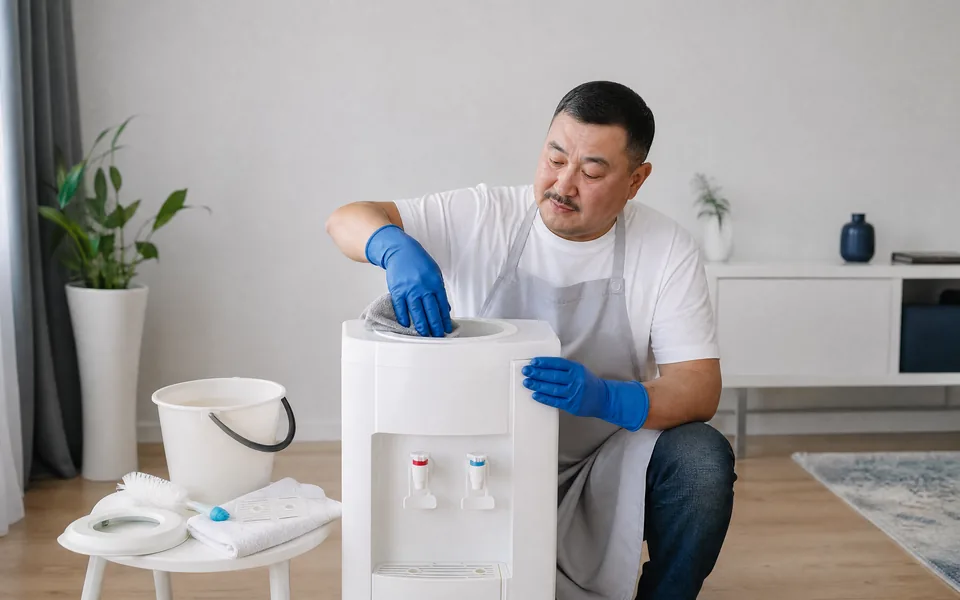
- Wiping the taps and outer surfaces. We clean the tank; everything touched by hands is yours
- Telling us when you move: we keep records by address, and a unit that moves without a word gets lost in the delivery schedule
- Obvious damage. Flooded electronics, a cracked casing, a torn cord — that is not wear
Everything else is our concern, and the line is drawn by one rule: wear and breakdowns are ours, damage is yours. If it stops cooling, the intake unit leaks or the compressor starts knocking, we bring a working unit and take this one away, without investigating the cause in your kitchen.
A separate word about moving. You can take the unit to your new address yourself, but it is better to tell us in advance: the water delivery route is tied to the address, and a move without warning ends with the courier visiting an empty flat. Carry it upright, and let a compressor model stand for a few hours after the journey before switching it on.
And about what we do not ask for. No handover certificate, no photos of its condition, no deposit for the hardware: the only deposit in our terms is for the bottles — 45 000 UZS for polycarbonate and 30 000 UZS for PET — and it comes back with them. The arrangement rests on you continuing to order water, not on signatures.
This also shows what a dispute looks like. In essence there is nothing to argue about: the unit stops working, we replace it and sort it out on our side. The only case discussed separately is obvious damage, and obvious here means visible to the eye, not deduced from circumstances.
The most unpleasant case deserves a separate mention — a leak onto the floor. A unit with sound plumbing does not make puddles by itself: water on the floor almost always means an overflowing drip tray or a badly seated bottle. That is why we ask you not to push the unit where the tray cannot be reached: five seconds a week are cheaper than any dispute with the neighbours below.
Companies with several units find it handy to check the list once a year: which one stands where, who is responsible for it and whether one has moved to another floor along with a department. We do this check on request and send a list by address — five minutes of work that removes half of the future questions about whose unit it is and why a rate was charged for it.
How much it costs to rent a water cooler
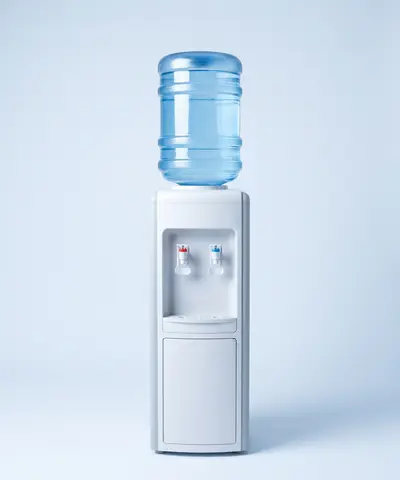
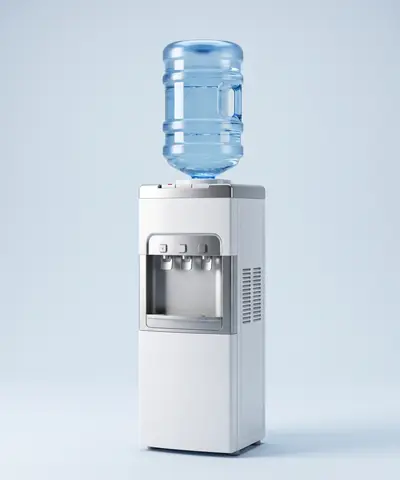
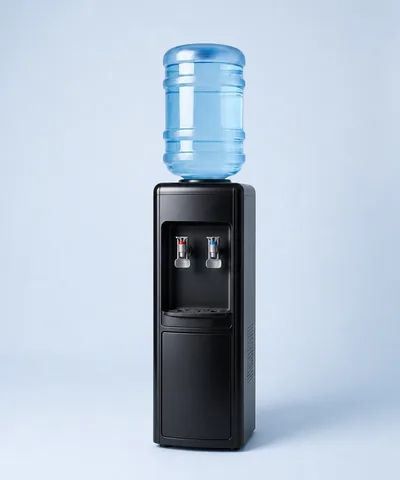
We have three rates, by unit type: 50 000 UZS a month for a desktop cooler, 80 000 UZS for a floor-standing one with electronic cooling and 90 000 UZS for a compressor one. The difference is exactly as with buying — what costs more to buy costs more to rent.
It is worth saying separately that monthly water cooler rental prices are almost never published openly in the city. Most companies write one line — about free use with volume — and suggest clarifying the rest by message. We state the rate straight away so you have something to calculate with, and we do not hide the free-use threshold either.
Short terms: a month, a season, a renovation
A monthly rate suits more than those saving at the start. There are situations where the unit is obviously needed for a short time, and buying it would be odd even with the most favourable arithmetic.
- Building work and renovation: the crew needs water for two or three months, then the unit is taken away
- A seasonal outlet: a summer terrace, a kiosk, an event site
- A temporary office during a move or a separate project
- A rented flat you may have to leave at any time
- An event of one or two days: a conference, an exhibition, a shoot
Short terms are charged the same way as long ones — monthly and by unit type: 50 000 UZS for a desktop cooler, 80 000 UZS for a floor-standing one with electronic cooling, 90 000 UZS for a compressor one. A part month is discussed separately; there is deliberately no ready rule on the site, since it depends both on the term and on whether water was ordered that month.
On building sites and in workshops people usually take a compressor cooler: they drink a lot and continuously there, and electronic cooling cannot keep up. For events, by contrast, a desktop one is more common — it is lighter and can be taken away together with the table it stood on.
The free-use threshold works exactly the same on short terms. A crew of fifteen drinks 15 bottles in a week or a week and a half, and on such a site the unit almost always stands without a rate. A summer terrace with ten seats may or may not reach it, and you can work that out in advance from the number of seats and the length of the season.
For companies, short terms are handled the same way as long ones: an invoice, closing documents, a line for water and, if there is one, a line for the unit. We do not draw up a separate contract for the hardware — it comes as an addition to the water supply, and that applies equally to two months and two years.
The rate and the water appear on the invoice as separate lines, and this is not a formality: they show exactly what changes from month to month. In a month when the threshold is reached, the unit line simply does not appear — there are no zero items on the invoice, because each new accountant would need them explained. The same principle applies in messages: we state the total before delivery, not after.
The only thing worth warning us about in advance is the date the unit should be collected. On building sites people remember it on the last day, when the site cabin is being removed, and the courier arrives at locked gates. One message a couple of days ahead settles it completely.
An event of a day or two is counted differently, and it is the only case where billing is not by the month. The unit is brought the day before so that it reaches temperature by morning, and collected the day after the event ends. Water for such an event is ordered with a margin: it is easier to count it by the number of guests than to look for somewhere to buy another bottle on a Sunday. We quote the full total for such an order in advance, including delivery and collection.
A rented flat is a separate line on this list and the most common one. The unit there is not tied to the renovation or the furniture: when you move, it leaves with you on the same run or comes back to us if the new address is not yet known. A purchase in the same circumstances becomes a thing you have to transport, store or sell — and it usually sells for a third of the price.
Water delivery with cooler rental: how it works
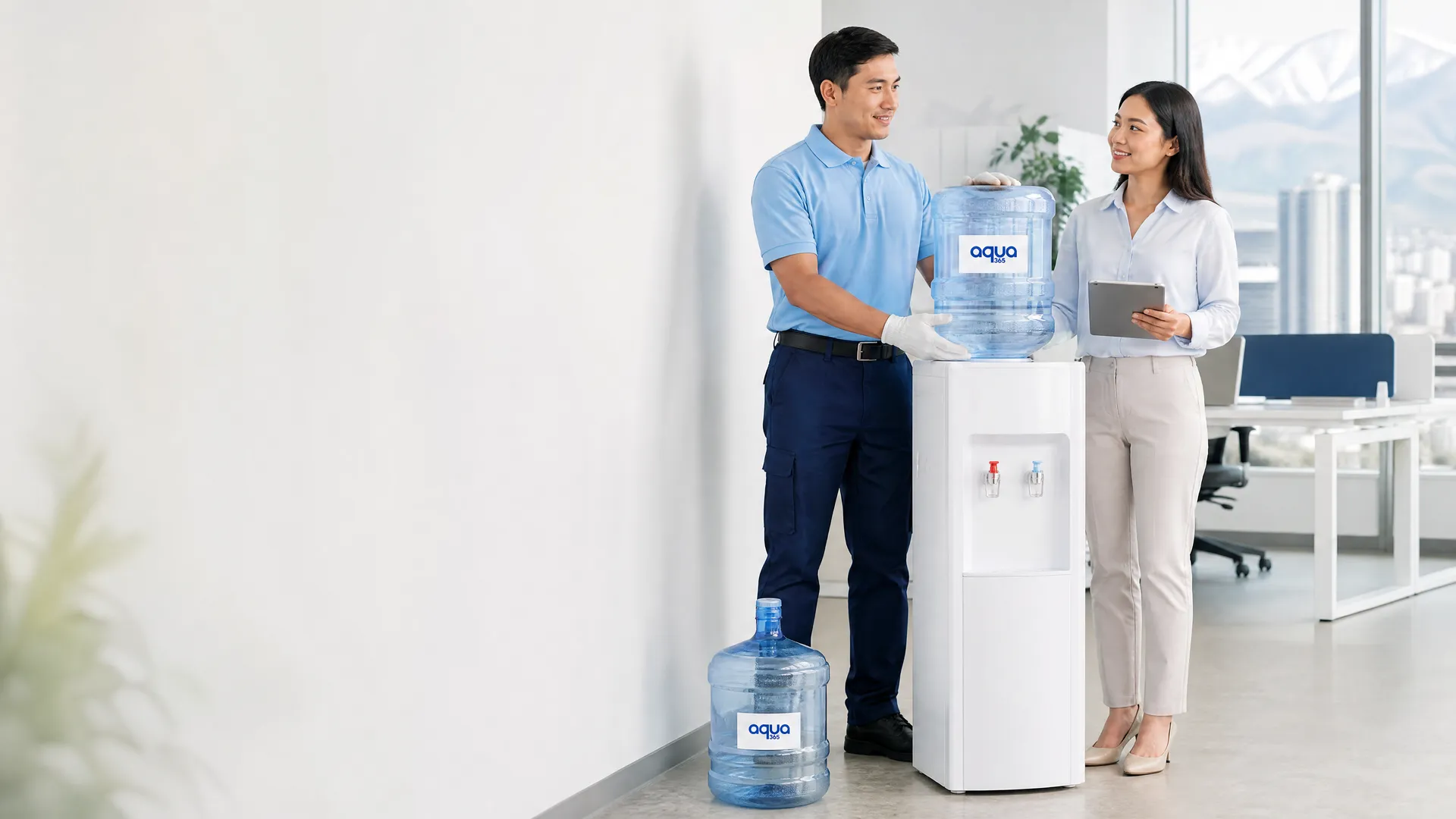
You can order a rented cooler with water in one message: how many people drink, where to deliver and whether you need hot water. After that everything comes on one run — the water and the rented cooler arrive together, with no separate visit from an installer. Delivery across the city is free from 2 bottles, an order placed before 10:00 usually goes out the same day, delivery windows — 9–13, 13–17, 17–21.
After that you simply order water as you would without the unit: the courier brings full bottles and takes away the empties. Cooler rental and water delivery go on one line in one chat, and there is no separate contract for the hardware to sign.
Who this arrangement does not suit
There are two cases when renting a cooler is a bad idea. The first: you definitely live in your own flat, consumption is small and steady, and in two years you will still be drinking this water. Then buying is cheaper, and there is nothing to argue about.
The second: you need a particular unit with particular features — to match the kitchen, with a fridge compartment, bottom-loading. Rental coolers come from a fleet, and the choice is narrower than in a shop. If the look and the model matter, get your own and order sanitising from us separately.
How to finish: return, swap and buy-out
You can leave this arrangement at any time and without paperwork. The only difference is what you want to do — return the unit, swap it for another or keep it.
- Message the chat before the next delivery: the courier will come with water and collect the unit on the same run
- Drain the tanks the day before — the hot one has a plug at the back, the cold one drains through the tap
- Take off the bottle and empty the drip tray so water does not splash while it is carried
- Hand over the unit together with the empty bottles: the bottle deposit will be refunded on the same visit
- If you need it again in a month or two, just say so — we will bring the same kind, and nothing has to be set up again
Swapping the model is even simpler: the unit is replaced on one run, and most often it is replaced with a bigger one. Desktop for floor-standing — when people started drinking more than expected. Electronic cooling for compressor — when cold water stopped lasting until the middle of the day. The reverse swap happens too, usually after an office has downsized.
A buy-out is priced from the residual value: we look at how long the unit has been with you and what condition it is in, and quote a figure in the chat. There is deliberately no ready formula on the site — it would depend on the model and the term, and any published figure would be wrong half the time. The rule of thumb is simple: the longer the unit has worked, the closer the figure is to zero.
The same arithmetic this page starts with tells you when it is time to switch to buying. If the rate has been charged every month for a second year running, you have already paid roughly the price of the unit and are now paying for something that under the other arrangement would be yours. That is the moment to ask about a buy-out. If the rate has never been charged, there is nothing to change: free use cannot be beaten.
And one last point about swapping: it does not reset the history. The threshold is counted on your water orders, not on a particular cabinet, and swapping a desktop unit for a floor-standing one mid-month does not affect it at all. The same goes for a break — a month without the unit cancels neither the previous orders nor the terms on which it returns.
And the question asked least often, although it happens more than anything else: what if you simply stop ordering water. Nothing terrible. We will message you and ask whether you still need the unit, and either resume deliveries or collect it. The rate for idle months is charged as usual, so staying silent does not pay, while telling us costs nothing.
A separate word on settling up. There are no deductions for early return, because there is no term to break: the arrangement is monthly, and a month started and ended early is closed on the actual figures. There is nothing to argue about here, and that is probably its main convenience compared with buying.