







Bottle handles: what changes when you carry it
A full nineteen-litre bottle weighs about twenty kilos including the container. Without a device, people carry it hugged against the stomach: the centre of gravity moves forward, the lower back compensates by leaning back, and by the second flight of stairs your back lets you know about it.
With a bracket on the neck, the load hangs along your body like a heavy suitcase. Your wrist, forearm and shoulder do the work, your spine stays straight and your body stays balanced. The weight does not go anywhere: twenty kilos are still twenty. What changes is which muscles hold them and where the load goes.
The second difference is a free hand. A bottle hugged to the chest blocks your view and takes both hands: the entrance door, the lift button and the handrail all have to be tackled with a shoulder. With a grip, one hand is always free, and that is exactly why the stairs feel calmer.
Weight is not the only thing that makes the bottle awkward. Its plastic is smooth, its shape has not a single ledge, and it arrives from a van or a cold storeroom covered in condensation — so a wet side in your arms slides down by itself. The grip deals with that too: you hold the loop, not the slippery wall.
There is also a number that explains everything else. A standard flight is ten to twelve steps, and on each one the weight has to be lifted, not just held. Five floors add up to about sixty lifts of the load to the height of a step, and the difference between “weight at arm’s length” and “weight along the body” is multiplied by exactly that number.
How much a full bottle weighs and what your hand holds
Any talk about carrying starts with a number that is rarely said out loud. Twenty kilos is not a figure of speech: that is what a full nineteen-litre container weighs together with the bottle itself. For comparison, it is a sack of sugar or two crates of water in small bottles.
You can check your own figure without scales: a litre of water weighs a kilo, so the weight of a full bottle equals its volume in litres plus the weight of the bottle itself — under a kilo for a nineteen-litre one. That is why the table below says twenty rather than nineteen.
| Bottle | Weight with water, approx. | How it is usually carried |
|---|---|---|
| 19 L bottle | about 20 kg | hugged with both arms or by a neck grip |
| 12 L bottle | about 13 kg | with one hand by the neck, over a short distance |
| 10 L bottle | about 10.5 kg | by the built-in handle in the bottle body |
| 5 L bottle | about 5.3 kg | by the handle, usually two at a time |
| Empty 19 L bottle | under a kilo | with one hand, but its bulk blocks your view |
Then comes biomechanics, and it is simple. An adult’s hand holds this weight with no trouble — the issue is not strength but where the load sits relative to the spine. A container pressed to the stomach moves the centre of gravity twenty to thirty centimetres forward, and to avoid falling the body leans back. In this position the lower back works as a lever rather than a support.
A neck grip brings the load back to the body. The arm hangs along the torso, the weight goes straight down to the floor through the shoulder, hip and foot, and the spine hardly takes part. You feel the difference on the first flight, and by the third it is decisive.
There is a third way people forget — carrying it between two people. Over a short, level distance it beats any device, but on stairs it is the worst of all: the person below takes most of the weight and does so in the most awkward posture.
Two full bottles are not carried at once, and strength has nothing to do with it. Forty kilos in two hands rob you of balance exactly where you need it most — on the turn of the stairs and at the threshold — and with both hands busy you can open neither a door nor the lift. The rule is simple: one trip, one bottle.
How a bottle carrying handle sits on the neck
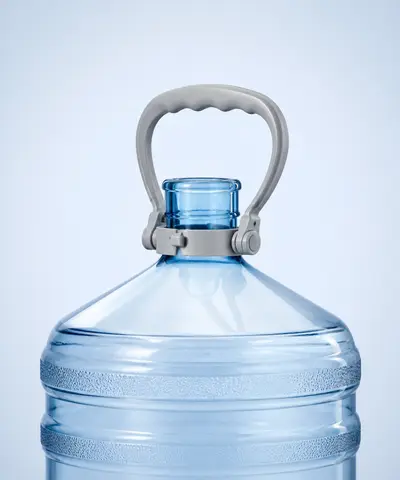
The design could hardly be simpler. A bracket or clip grips the rim under the cap — the same protruding collar people usually hold the bottle by with their fingers. The lock snaps shut, the loop comes up, and from then on you carry the bottle by it.
The one habit worth getting into: after the lock snaps, lift the bottle about ten centimetres and only then start walking. A lock that has not fully engaged shows itself at exactly this moment rather than halfway up the stairs.
Snap the lock with both hands, not one: hold the bottle with the other, or it slides away from the push and the bracket sits on the collar at an angle. On tiles this is most noticeable — a full bottle slides across them at any pressure from above.
The neck of polycarbonate and PET bottles differs in diameter and in the shape of the collar. Some grips are made universal and fit both, some fit only one. So when you order, name your bottle — polycarbonate or PET; we use both, and they are easy to mix up.
The grip holds on an empty bottle just the same, and there is no need to take it off between deliveries. There is one thing to check: the collar differs slightly in height between factories, so a grip that fitted the last bottle like a glove sometimes sits with some play on the new one. The same trick of lifting it a hand’s height settles the question in a second.
What kinds of grip there are
They look alike, but they differ in two things: how they hold the bottle and how they hold your palm.
- A rigid bracket with a lock: the most common type, it sits on the collar under the cap and opens when you press the catch.
- A spring clip: the same thing, but without a lock — held by a spring, it goes on instantly and sometimes comes off by itself.
- A strap grip: a textile band wraps round the neck, the loop is soft and does not cut into your palm, but it is harder to thread on.
- A two-handed yoke: two grip points on one bottle, the weight is shared between both hands, but its width gets in the way in a narrow stairwell.
- A sleeve for the bottle body: it goes on the bottle itself, is rarely seen and does not survive on returnable bottles — it is removed for washing.
Choosing between them means choosing between speed and reliability. A clip goes on in a second and comes off in a second too, including when you do not expect it. A bracket with a lock needs a two-finger movement but will not open by itself. On the stairs the second wins, at the car boot the first.
A soft cover on the loop looks like a trifle right up until you have carried a load up five floors. A narrow rigid loop under twenty kilos leaves a red line on your palm within half a minute, and after that you are shifting the weight from hand to hand rather than carrying it.
Any of them fits in a kitchen drawer: the largest is no bigger than a folding umbrella. This, by the way, is a separate argument against a trolley, which needs its own spot in the hallway and gets in everyone’s way until it is needed.
A bottle grip, a trolley or a bottom-loading cooler
All three have the same task — not lifting twenty kilos in the air. They solve it differently, and the choice depends on where exactly it is hard for you: on the stairs, in a long corridor or right at the cooler.
| Solution | Where it wins | Where it loses |
|---|---|---|
| Neck grip | stairs, stairwell, car boot, moving it around the flat | the weight stays the same, it is just easier to hold |
| Trolley | a long level route: an office corridor, a car park, a warehouse | steps, thresholds and a lift with no room |
| Bottom-loading cooler | the lift disappears entirely: the bottle slides into the cabinet from the floor | the price of the appliance and a pump that needs servicing |
The first costs less than the other two put together, and that is its main argument. We have a separate page on bottom loading: if it is hard at the cooler itself rather than on the way to it, look there.
Read more: Bottom-loading water coolers
A fourth way exists, and it is called the car boot. People bring water from the shop themselves, and the task there is different: not carrying it, but getting it out. The bottle lies on its side below the edge, and you lift it from a bent position at arm’s length — the most awkward posture there is. This is where the grip helps most: it takes hold of the neck from above rather than the slippery side.
What they are made of and what to look for
- Material: impact-resistant plastic or a metal bracket with a cover. Both work, but on plastic the lock breaks, and on metal the cover wears off.
- Grip width. A narrow rigid loop cuts into your palm under twenty kilos — a soft or wide cover is not a luxury here.
- Stated load. It should start at twenty kilos, not nineteen: the bottle weighs something too.
- The lock. It is the only weak point of the whole design, and cheap products break right there.
- Compatibility with your neck — a universal model or one for a specific type of bottle.
The weight of the product itself hardly matters: next to the load it is lost. The shape of the loop does matter, though: a round cross-section is more comfortable than a flat one because it does not twist your wrist.
Check the stated load before you buy, not after: if the description does not mention it at all, that is an answer in itself — a manufacturer confident in its lock does not keep quiet about it. And one more practical detail: the loop should fold or swivel. A handle sticking up gets in the way when you put the bottle in the car boot or on an appliance.
You can test the product on the spot, and it takes half a minute. Snap the lock onto an empty bottle and pull it up with a jerk rather than smoothly: any catch holds a smooth load, but only a sound one holds a jerk. Then hold the lock’s hinge up to the light: a whitish line at the bend means the plastic is already fatigued, even though the product is new.
What happens to it and how long it lasts
Only one part of this design breaks — the lock — and it breaks predictably. A plastic catch works by flexing: every time the grip is snapped shut, the thin hinge bends open a little. It does not notice hundreds of cycles, but it notices thousands, and one day the catch stops clicking and just drops into place.
There is one sign of this, and you can spot it in advance: the lock has started to close more softly and quietly than before. Such a grip is replaced without waiting for it to open on the stairs. Twenty kilos dropped from waist height break the bottle and whatever stands next to it.
The second weak point is the cover on the loop. Rubber wears and slips, foam crumbles and soaks up water. This does not affect the load capacity, but it greatly affects comfort, and it is the most common reason a grip gets replaced early.
Frost is no friend to plastic: in the cold it becomes brittle, and a lock that flexed in summer cracks in winter. So a product that lives in a car boot lasts noticeably less than one kept in a drawer at home. A metal bracket does not suffer from this at all, but its cover wears off and its spring rusts if it is washed and not dried.
The grip is worth washing simply because it touches the neck — the very part of the bottle that a pump later sits on or that goes onto an appliance. Warm soapy water once a month and air drying is the whole procedure.
You cannot give its service life in years, and the honest answer is: count the lifts. For someone who carries a bottle twice a week, one grip lasts for years. For someone who unloads a supply van, it lasts a season, and such a person buys a second one in advance.
A broken grip is not repaired: the lock hinge is a moulded part, and glue does not hold on it under load. Throw it away at once instead of putting it back in the same drawer just in case: one day someone will grab exactly that one in a hurry and find out on the stairs.
What it costs and when you can do without it
The price is 20 000 UZS, which is less than one bottle of water. Against that, talk of payback seems odd: either you physically need it or you do not.
There is one case where you do not: the bottle stays in one place on the cooler, and the courier brings it and puts it on. Carrying it up to your floor and putting it on the cooler are part of our delivery and cost nothing, so many customers never have to carry a bottle at all.
It is needed by those who bring water from the shop themselves, who move the bottle around the flat or between floors of the house, who keep a stock at a dacha, in a garage or in a workshop, and by those whose building has no lift. The second bottle falls into the same category: it has to be carried to the door too, even when empty.
A separate group are those who buy a grip for someone else. It costs less than one bottle of water, fits in a jacket pocket and fully solves someone else’s everyday difficulty, so it is often added to an order for parents or for a dacha people rarely visit.
It is bought once, and that is what sets it apart from everything else that comes with the water. Bottles go back, water runs out, a pump wears out, but the grip just lies in a drawer between deliveries and house moves — and people remember it exactly when they need it.
A bottle stand: where to put what you have carried
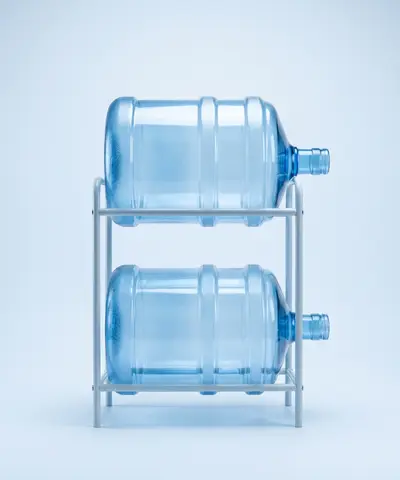
Carrying it is half the job; the other half is where to put the bottle. On the floor it stands steadily, but pouring from it is awkward: the neck ends up a hand’s height off the floor. A stand raises it to knee or table height, and with that several everyday questions are settled at once.
- Pouring standing up: you hold a glass or a saucepan under it without crouching.
- You can see the floor under the bottle: a puddle from a leaking spout is noticed the same day, not a week later.
- The bottle stops being an obstacle: nobody kicks it or knocks it over with a mop.
- An empty bottle is easier to take off: from knee height you lift it with one hand, from the floor with two.
A stand is chosen by two numbers: height and seat. The height decides what you pour with, and the seat must hold the bottom of the bottle, not its side, or a full bottle will rock at every press. The stand costs 150 000 UZS.
Its spot is chosen where the bottle stands now: closer to the sink than to the cooker, not in a walkway and not right against the wall — you need room in front of the neck for a hand holding a glass. And preferably on a level, hard floor: on a carpet or soft flooring, a stand with a full bottle tilts over time.
And a third detail for those who carry water themselves: where to keep the empty bottle until the courier comes. Empty bottles are gathered in one corner and not stacked more than two high — they are light but bulky, and the whole stack falls at once.
How to carry twenty kilos without hurting your back
- Lift from the floor with your legs: crouch, grip, straighten up. Do not bend over the bottle from the waist with straight legs.
- At the start, hold the loop with both hands and only then switch to one — that tests both the lock and your own reserve of strength.
- On the stairs keep the load close to your body and do not twist your torso: weight at arm’s length wrenches the lower back.
- Switch hands every one or two flights, even if it feels like you could go further.
- Do not carry the bottle together with shopping bags: your free hand is for the handrail, not for groceries.
A separate word on hands and footwear. Damp palms and slippers with smooth soles cancel out all the technique at once: it is not the load that slips, it is you. Wipe your hands before lifting, and let a bottle that has come in from the frost dry off — otherwise condensation runs onto the loop at the very moment you shift the weight to one hand.
A handle for 19 L bottles is added to a regular water order, with no separate run needed. Bottles start from 21 000 UZS each, and delivery across the city is free from 2 bottles in an order — message us on WhatsApp with the type of bottle you have, and we will bring a suitable option together with the water.