






Bottom-loading water cooler: what it does away with
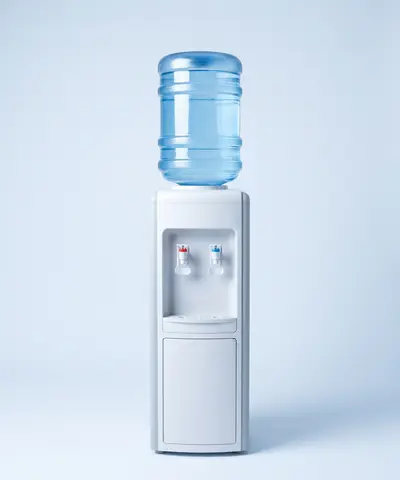
A full 19 L bottle weighs about twenty kilograms including the bottle itself. With the classic design you have to lift it off the floor to about chest height, turn it upside down and get the neck into the socket — all in one go, with no chance to change your mind halfway. A puddle on the floor is not unusual here but the normal outcome when someone does it alone and without practice.
Bottom loading does away with exactly that moment. The bottle stands upright on the floor of the cabinet behind a door, and it only needs lifting over the sill — about five centimetres, from the floor into the cabinet. The pump inside the unit does the rest.
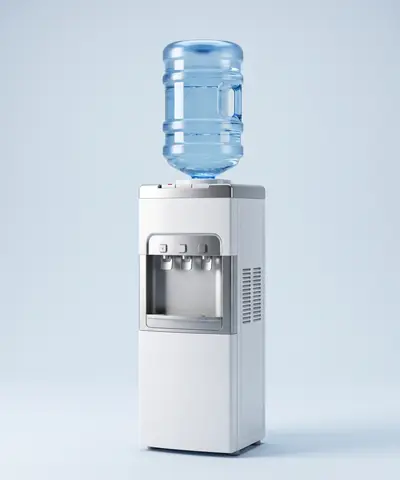
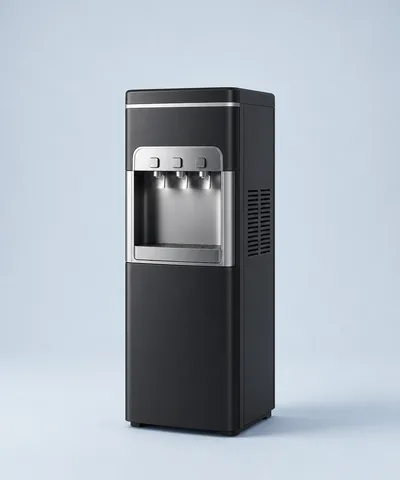
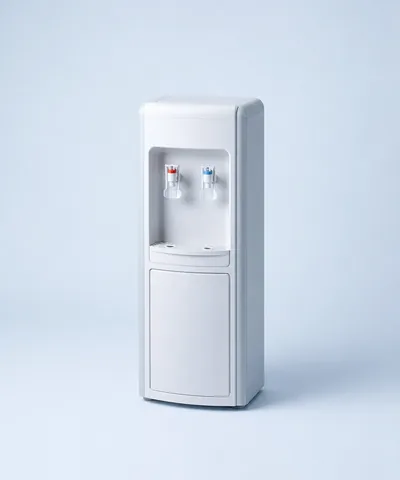
A side effect that makes such models popular in private offices and meeting rooms: the bottle is out of sight. The unit looks like a slim cabinet with taps rather than a structure with a big blue container on top.
The closed cabinet has a downside people discover only after buying: you cannot see the bottle, and so you cannot see the level. You have to tell how much water is left from an indicator, and if there is none — from memory or from the pump running longer than usual.
Such a unit is the same size as an ordinary floor-standing one, give or take a few centimetres: the bottle was always within its footprint, just on top. The difference is that the centre of gravity has moved down, which makes the unit steadier — it is harder to knock over with your foot than a classic one with twenty kilograms on its head.
How a floor-standing bottom-loading water cooler works
It comes with an adapter cap with a tube and a weight at its end. The tube goes down the bottle neck to the very bottom, the adapter sits on the neck, and the door closes. Then an electric pump takes over: it draws water up the tube and fills the internal tanks — cold and hot, as in an ordinary cooler.
The pump switches on by itself when the level in the tank drops and runs for a few seconds. Most models have a sensor and an “empty bottle” light: the pump stops before it starts pumping air.
The pump itself is a small 12-volt diaphragm unit; it sits in the cabinet next to the tanks and runs off the same power supply as the unit's electronics. Its life is counted not in years but in the number of starts, and it starts more often the smaller the tanks are: in a model with a large cold tank the pump runs less often and lasts longer for the same water consumption.
Hence the main difference that product listings rarely mention: the water is lifted by electricity, not gravity. With the power off, such a unit will not pour anything — neither cold nor room-temperature water. A top-loading cooler in the same conditions still gives at least warm water by gravity.
What happens when you change the bottle
Changing the bottle with this design is a few short movements instead of one heave, and they are all done at waist level or below. In words the difference seems small; in practice it is the reason people buy these units.
The steps are the same on every pump model and take a couple of minutes:
- Remove the cap or stopper from the new bottle and wipe the neck dry: anything left on the stopper will end up inside.
- Take the adapter cap with the tube out of the empty bottle, rinse the tube under running water and wipe the adapter.
- Lower the weighted tube into the new bottle to the very bottom and screw the adapter onto the neck.
- Move the bottle from the floor into the cabinet — it only needs lifting over the sill, about five centimetres.
- Close the door, press the tap and wait: the pump primes the tube in twenty seconds to a minute, and the first streams come out with air.
- Pour away the first glass — it holds water that stood in the tube since last time.
People argue about the first glass, and needlessly. Between draws there is always water left in the supply tube, and it stands there at room temperature — which is exactly why sanitising gets more attention on this model than on a gravity-fed one. Pouring away half a glass every two days is a ten-second habit that removes half the questions about aftertaste.
The weight at the end of the tube deliberately keeps it just above the bottom, and there is no need to lengthen or trim the tube to reach lower: it would go into the sediment that builds up in any bottle over time. The glass or two that cannot be drawn from the bottom is the price of leaving the sediment in the bottle rather than in the tank.
A separate word about air. If the pump delivers water in spurts with a hiss, most often the adapter is not sitting tightly on the neck or the tube has cracked right at the fitting. That is where the air gets in, and the fix is a tight fit or a new tube, not a pump repair — the pump is the last thing to look at in such cases.
And about the empty bottle. It is easier to take out of the cabinet by tilting it on its bottom edge rather than lifting: an empty bottle weighs about a kilogram, but it is tall and catches its neck on the top of the recess. People who do it every week all end up with the same movement — tilt first, then take it out.
Who really needs it
- Older people: lifting twenty kilograms to chest height is exactly what bottom loading was invented to avoid.
- People who live alone and will change the bottle themselves, with no helper at hand.
- Anyone with back, shoulder or wrist problems: with this design the weight is never lifted above the waist.
- A private office, reception or meeting room, where a unit with a bottle on top looks out of place.
- A kitchen with a low wall cupboard: an ordinary cooler needs free space above it to turn the bottle over.
And another group people usually do not mention — families with small children. The point is not the weight as such but that lifting and turning the bottle is the only moment when twenty kilograms are held above the unit. Nobody likes doing that in a kitchen with a child underfoot.
The weight deserves a closer look, because twenty kilograms is a deceptive figure. What is dangerous is not so much the weight itself as the way it is lifted: from the floor, with arms outstretched, twisting the body, with a load that shifts mid-movement because the water sloshes inside. This combination causes back injuries more often than lifting the same weight from a comfortable stance, and bottom loading removes everything from the movement except the weight itself.
And the opposite case: an office where the facilities manager changes the bottle every two days and a second pair of hands is always nearby has no reason to pay extra for a pump. There the simple top-loading design wins, because there is almost nothing in it to break.
What you pay for the pump
An honest talk about the drawbacks is short, but there are four of them. The pump is an extra part, and it wears out; you can hear it when it draws water, though only briefly. There is always water standing in the supply tube between draws, so such a unit is sanitised not less often but more carefully, and the tube is replaced or rinsed separately. Finally, some models cannot draw the last glass or two from the bottom: the empty bottle is not quite empty.
Add a small detail that comes up when moving: a pump unit is heavier and taller than a comparable gravity model, because its cabinet is not decorative but load-bearing — it holds twenty kilograms. Two people carry it easily; one person on the stairs, no longer.
The fifth in the same row is dependence on spare parts. A gravity model has almost nothing to break, and a five-year-old unit can be fixed with any tap from the market. With a pump model, a repair comes down to a specific part from a specific manufacturer, and the rarer the brand in the city, the longer you wait for it.
| What we compare | Bottom loading | Top loading |
|---|---|---|
| How the bottle goes in | moved from the floor into the cabinet | lifted and turned over |
| What raises the water | an electric pump | gravity |
| Without electricity | does not work at all | warm water flows by gravity |
| Extra servicing | the pump and the supply tube | only the tanks and taps |
| Price | higher: from 1 249 000 UZS | lower: from 999 000 UZS |
Care: what gets rinsed in a pump unit
Sanitising here differs from the usual not in difficulty but in the parts involved. Besides the tanks and taps, the adapter, the supply tube and the non-return valve are flushed — that is, everywhere water stands between draws. A top-loading unit has no such section at all: there water flows by gravity along a short path.
The frequency depends on consumption, not the calendar. With ordinary home use the tanks and tube need attention every six months, in an office with constant use every three to four months, and more often in summer: warm water in the tube develops a life of its own faster. The taps and drip tray are wiped every week, and that is not cosmetic — drips under the tap are the first to build up deposit.
| Part | How often | With what |
|---|---|---|
| Supply tube and weight | at every bottle change | running water, outside and inside |
| Neck adapter | at every bottle change | wipe dry, check the seal |
| Taps and drip tray | once a week | soft cloth, take out and empty the tray |
| Tanks and internal path | every three to six months | sanitising, included in servicing for rented units |
| Cooling grille at the back | every six months | a dry brush or a vacuum cleaner |
What not to do. Boil the silicone tube — it loses its shape and stops holding on the fitting. Pour bleach or household chemicals into the tank: traces stay inside and end up being drunk. Wash the tube in the dishwasher with the dishes — it comes out smelling of rinse aid, and that smell faithfully reaches the glass.
And one rule that applies only to the pump design. If the unit has stood unused for several days — at a dacha, in a closed office, after a holiday — the first bottle is run through without drinking: pour away two or three litres and only then drink. Standing water in the path changes taste more in a week than in a month of regular use.
A rented unit is simpler in this respect: we sanitise it and replace the tube on schedule and charge nothing for it. A purchased one is serviced by the owner or on request — the tube and adapter are consumables much like a filter cartridge, and they are replaced not because they break but when they are due.
Pump silent or humming: what to check, in order
The pump is the most noticeable part of the design, and it is the first thing people suspect. In service experience it breaks less often than it gets blamed: more often the culprit is the tube, the adapter, the bottle itself or the power. So the check starts with what is quick and free, not with taking the cabinet apart.
- Power: the unit is plugged in, the switch is on, the indicator is lit. Without electricity this design pours nothing at all.
- The bottle: it has water in it, the empty-bottle light is off, the bottom is not showing.
- The tube: lowered down to the weight, not pushed up by the door, not pinched and not cracked at the fitting.
- The adapter: sits tightly and fully on the neck, with the O-ring in place.
- The tap: if you hear the pump but no water comes, the problem may be a blocked tap rather than the supply.
| What happens | Usual cause | What to do |
|---|---|---|
| The pump hums, no water | the tube does not reach the water or is pinched | adjust the tube, check the adapter fit |
| Water comes in spurts, with a hiss | air getting in at a joint or a cracked tube | refit the adapter, replace the tube |
| The pump does not stop | the level sensor in the tank | switch off the unit and call a technician |
| The empty-bottle light is on with a full bottle | the sensor or a contact | reseat the bottle, then call the service |
| Not pumping, no sound at all | power, a fuse or the pump itself | check the socket, then call the service |
Before anything else, check the bottle itself. A bottle with a crack near the bottom or a deformed neck gives exactly the same picture as a faulty pump: air getting in, spurts, water left at the bottom. Move the tube to another bottle — it is the quickest check of all and rules out half the cases.
With a rented unit this list rarely gets as far as the word “service”: the unit is simply swapped for a working one. With a purchased one the pump is replaced as a separate part, and it matters that someone in the city does this — which is why service is on the list of things to check when buying.
A cooler without a bottle is a different appliance
In search this query most often means not bottom loading but a purifier: a unit that takes water from the mains and cleans it with filters inside the cabinet. There is no bottle at all, and nothing to deliver. It is a separate story of connection, cartridges and cost of ownership, and it has its own page on the site.
With bottom loading the bottle is still there, just out of sight. Water is still delivered to you, the bottles are still collected, and the deposit for them is still refunded. The only thing that changes is how high you lift it.
Money is counted differently in these two stories, and that is the one thing worth knowing when choosing between them. With a bottle unit you pay for the water and get the bottle deposit back; with a filter unit you pay once for the connection and then for cartridges on schedule. The first sum is visible every month, the second every six months, which makes it seem smaller than it is.
Buying a bottom-loading water cooler: price and what to look for
In Tashkent retail these coolers start from 1 249 000 UZS, against 999 000 UZS for a floor-standing top-loading model. The spread between models is wide: the price depends less on the pump itself than on the cooling method — compressor units cost more than electronic ones with either type of loading. We give the exact price of a specific model in the chat, because the stock in our warehouse changes.
- The height of the cabinet recess: polycarbonate and PET bottles differ in height, and not every one fits a tight recess.
- An empty-bottle indicator — without it the pump pumps air, and you find out by the sound.
- A removable supply tube: a fixed one cannot be rinsed or replaced.
- A hinged cabinet door rather than a magnetic one: a magnetic door gets knocked open by the bottle as it goes in.
- Service in the city. The pump is a part that gets replaced, and you do not want to travel to another city for it.
A separate word about something specifications never mention — the pump's loudness. Such models rarely state decibels, and the only way to know in advance is to listen to a working unit or ask someone who already has one. In a bedroom, a small studio or an office where you receive people, this matters more than the price difference between two models.
One more thing you can only see in person: how the door opens and how much room it needs. If the unit stands in a corner or between a cabinet and a wall, a hinged door will hit something, and you will have to pull the whole unit out to change the bottle. A door that comes off completely or opens flush with the side panel solves this at once.
If you do not want to replace your cooler
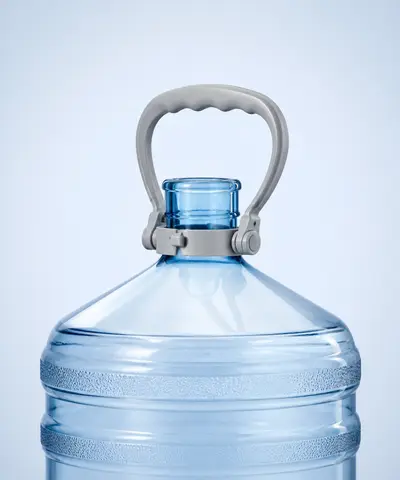
Three ways to avoid lifting the bottle without buying a new cooler. A neck handle (20 000 UZS) is the cheapest: it does not remove the weight but lets you carry it along your body rather than hugging it. A pump on the bottle — then the bottle stays on the floor or on a stand, and the water goes up through the pump. And the third: our courier carries the bottle up to your floor and puts it on the cooler himself — it is part of the delivery and costs nothing.
You do not even have to buy the unit. With regular orders of 15 bottles a month or more the rental is free, and the terms and rates are on the rental page. Water for any of these options costs from 21 000 UZS per bottle, with free delivery across the city from 2 bottles per order — message us on WhatsApp about your premises and who will change the bottle, and that is enough for an answer.