





Drinking water in glass: who needs it and why
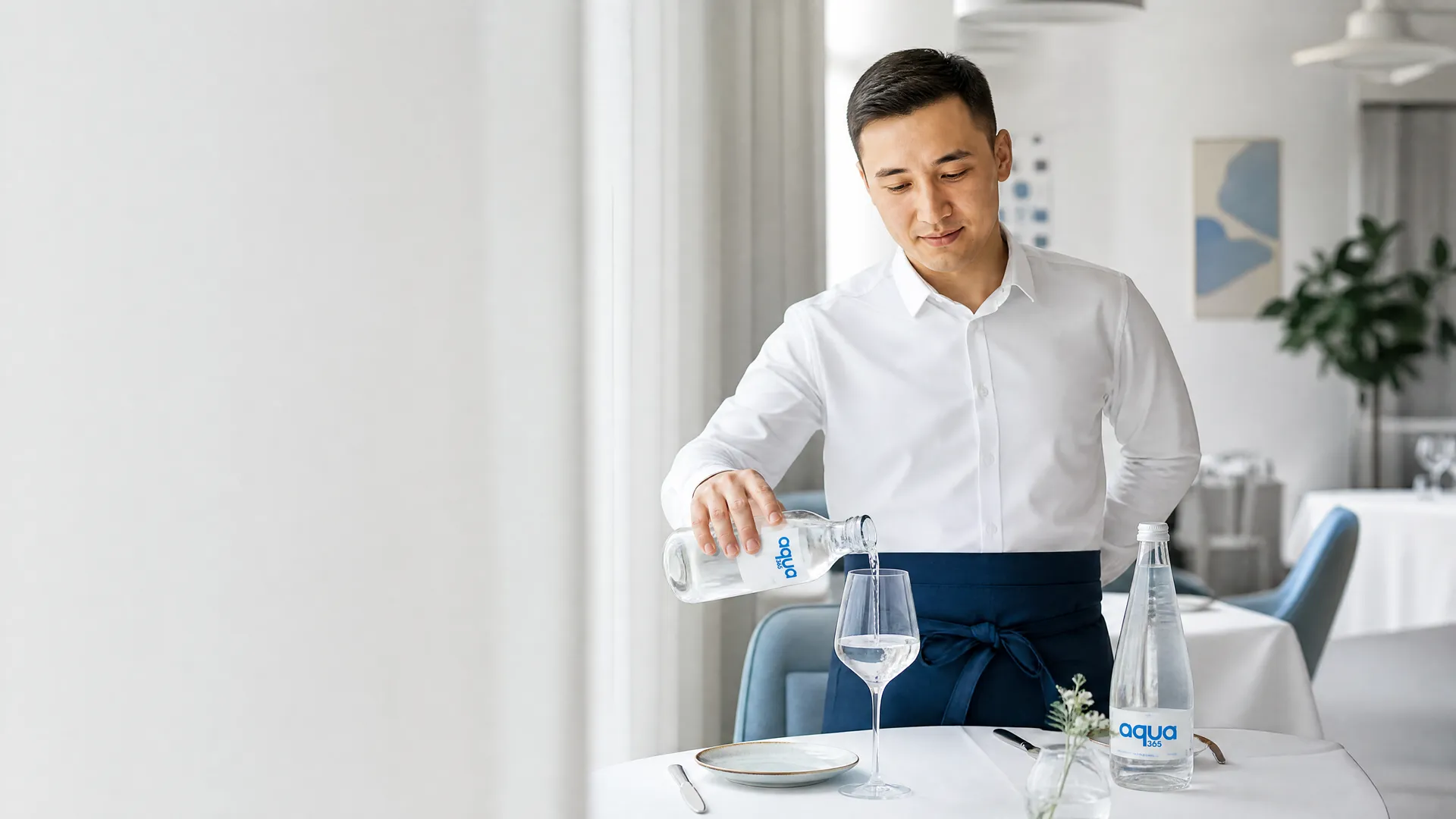
Glass is chosen wherever the guest can see the bottle. A restaurant, a meeting room, a reception, a photo shoot, a negotiating table — in all of these, plastic reads as cutting corners, even when the water inside is exactly the same. The second reason matters more than looks: glass is chemically inert. It gives nothing of its own to the drink — not in the heat, not in the sun, not after six months in storage — and the taste of the water does not change.
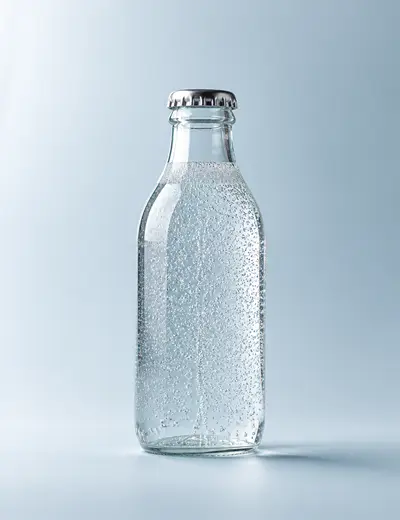
The third reason is the fizz. Carbon dioxide escapes through the walls of a plastic bottle noticeably faster, while in glass sparkling water stays lively to the last sip. That is why strongly carbonated mineral brands are almost always bottled in glass.
There is a flip side too, and it is fairer to say so up front.
- Weight — a pack of glass is roughly three times heavier than a plastic pack of the same volume
- Fragility — it has to be carried and stored with more care, and you cannot stack it high
- Price — you pay for the bottle itself, and that is most of the difference on the bill
- Sizes — glass is rarely filled above 0.75 litres, and there is no such thing as a glass 1-litre jug
What a glass bottle is made of and why it is inert
Glass is melted from quartz sand, soda ash and lime at around one and a half thousand degrees. The result is a uniform material with no pores, no fillers and no plasticisers: it simply has nothing to give to what it holds. A plastic bottle is more complex — the polymer contains additives that make it clear and flexible, and some of them slowly migrate into the drink in the heat. We are talking about tiny fractions that are regulated and tested, but with glass the question does not arise at all.
The second property is impermeability. The wall of a glass bottle lets neither oxygen in nor carbon dioxide out. Plastic lets both through: slowly, barely noticeably over a week, but perceptibly over several months of storage. That is why the same water has different shelf lives in different bottles — it is not about the water but about what surrounds it.
The colour of the bottle is not decoration either. Green and brown bottles block ultraviolet light; clear glass lets almost all of it through. In a shop window by the glass, a clear bottle warms up in the sun within a couple of hours, and with the heat goes the very freshness of taste that people buy this material for. If a pack sits in the light, choose a tinted bottle or move the crate into the shade.
Cap, thread and wall thickness
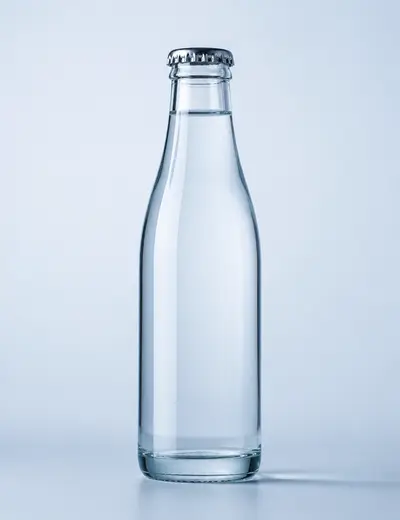
There are two ways to close such a bottle, and the choice between them is practical. A screw cap lets you close an opened bottle and carry it until the evening. A crown cap holds the gas more tightly, but it opens once and cannot be put back. A thread is handier for meeting rooms and offices, a crown cap for banquets: there the bottle is opened in front of the guest and finished at the table.
The walls of a drinking-water bottle are thin. The bottle is designed for one trip from the plant to the table, not for dozens of cycles like a 19 L large bottle, and its strength is calculated precisely for transport in a crate. So the crate here is not packaging for show: in its slot the bottle stands upright, while on its own it would knock against its neighbour on the first turn.
The conclusion is simple. A glass bottle is heavy and fragile not because it is badly made, but because otherwise it would not be glass. Inertness, tightness and the look on the table come as one set with the weight and with breakage when loading is careless — you choose the material as a whole, not for a single property.
One more property is worth knowing in advance: glass does not like sudden temperature changes. A bottle taken from the fridge cracks not because of boiling water as such, but because of the difference between the outer and inner walls — the inner wall expands faster than the outer one can keep up. For water this is rare, but in a restaurant kitchen where the same bottles are sometimes used for homemade lemonade or an infusion, people keep it in mind: first let the bottle warm to room temperature, then pour in anything hot.
Numbers explain more than words here. An empty 0.33-litre glass bottle weighs about three hundred grams; a plastic one of the same volume weighs fifteen to twenty. A crate of twelve full bottles comes to roughly eight kilograms, and almost half of that is the glass itself. That is what drives up the cost of transport, the rule of delivering by the pack rather than loose, and the habit of putting crates on the floor rather than on a shelf overhead.
Drinking water in glass bottles: sizes and packs
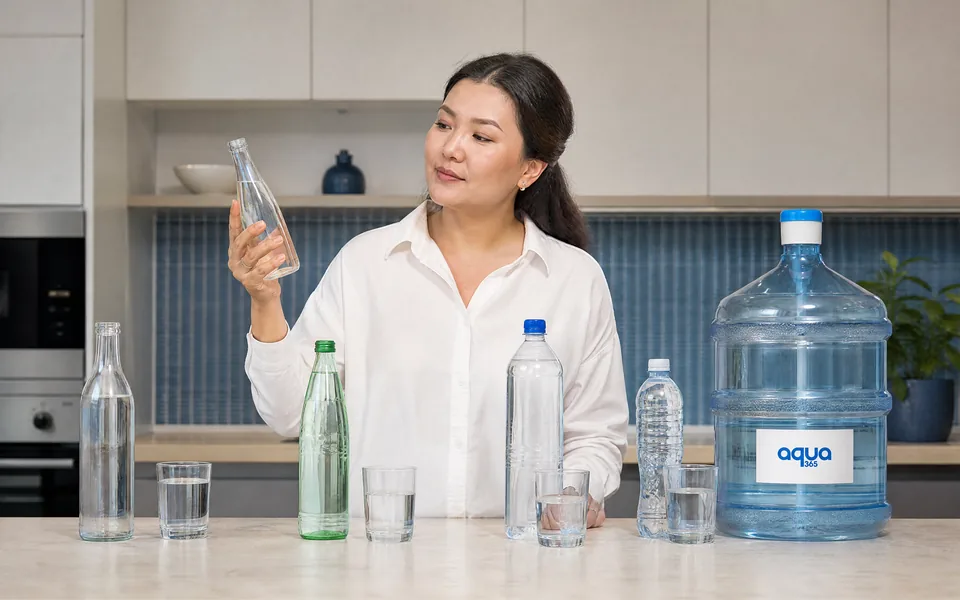
There are three popular sizes: 0.25, 0.33 and 0.5 litres. A quarter litre is set out as an individual serving at banquets, a third is the most common size for restaurants and meeting rooms, and half a litre is taken home and to the office. A pack usually holds twelve or twenty-four bottles per crate, and it is ordered by the crate: carrying glass loose is awkward and unsafe.
Bottled water in glass can be drinking, mineral or sparkling — the bottle has nothing to do with what is inside. You choose on the same principle as with plastic: first the type of water, then the carbonation, and only then the bottle size. On the delivery note the item is written just that way — drinking water in glass, with the size and the number of bottles per crate — so the order can be checked against the delivery in a single line.
| What we compare | Glass | Plastic |
|---|---|---|
| Bottle price | 6 000 UZS | 3 500 UZS |
| Empty bottle weight | Three times more | Next to nothing |
| How it holds the fizz | To the last sip | Goes flat within a few days |
| What happens to the bottle after | We collect and wash it | Goes to recycling |
How many bottles to order for a table or an event
Here you count in servings, not litres. A 0.33-litre bottle is one person's serving at lunch or a glass and a half at an hour-long meeting. At a buffet reception consumption is higher: one and a half to two bottles per guest over the evening, because some water is left unfinished and a fresh bottle is brought to the table. In a restaurant dining room the guide is not the number of guests but the number of covers — tables multiplied by turnover per day.
| Occasion | Per person | Convenient size | Example for 20 guests |
|---|---|---|---|
| Lunch or dinner at the table | 1 bottle | 0.33 L | 2 crates of 12 |
| Meetings of up to two hours | 1 bottle | 0.5 L | 2 crates of 12 |
| Buffet and reception | 1.5–2 bottles | 0.25 L | 3–4 crates of 12 |
| All-day shoot or conference | 3 bottles | 0.33 L | 5 crates of 12 |
| Coffee shop, daytime counter | Counted by seats | 0.33 and 0.5 L | 1–2 crates a day |
A second rule helps turn the table into an order: count the whole week, not a single day. A restaurant is busy differently on weekdays and weekends, a meeting room has a number of meetings a week, a coffee shop has a number of seats. That weekly volume becomes the figure a regular delivery grows from: name it once and adjust it as needed.
Sparkling and still are usually ordered in equal amounts, and for a banquet with more still water: it is also drunk by those who do not care for bubbles. Mineral water is set out separately and in smaller quantities; it does not replace ordinary water. Ordering it by the crate makes sense where people actually ask for it, not as a reserve.
Ordering too much is no great risk: the shelf life is long, a crate takes little space and needs no fridge until it is served. Ordering too little costs more — no one brings glass in the middle of the evening, and plastic from the nearest shop ends up on the table.
Staff are counted on a separate line. In the kitchen and behind the bar people drink more than in the dining room, and all day long, but glass almost never goes there: a large bottle with a pump or a water cooler fits better, and small bottles stay for guests. It is better not to mix these two kinds of consumption in one order. Otherwise the guest stock unexpectedly runs out by Thursday, the reason stays unclear, and the next order is placed with double the margin — when what was needed was to count them separately.
How to serve and store glass bottles
The serving temperature is eight to twelve degrees. Colder, and you taste nothing at all; warmer, and the water feels heavy. Chill it in advance in the fridge rather than with ice in the glass: ice dilutes the water and, if made from different water, brings its own aftertaste. Sparkling water is kept a little colder, around six to eight degrees — in cold water carbon dioxide is dissolved more densely and escapes more slowly.
- Do not keep crates in the sun or by the stove: heat and light spoil the taste faster than anything
- Do not freeze the bottle — the water expands and the glass cracks at the bottom
- Put an opened bottle in the fridge and finish it the same day
- Put crates on a pallet or a shelf, and do not stack them more than two high
- Wipe the bottle before serving: dust and fingerprints both show on glass
The routine at the table is simple. The bottle is placed with the label facing the guest, opened in front of them and left on the table rather than taken back to the bar. For a banquet a quarter litre is handier: it gets finished, and at the end of the evening there is no row of half-empty bottles that will be poured away anyway.
In an office the same rules work even more simply. The crate sits in the storeroom, the day's supply moves to the fridge in the morning, and the meeting room gets cold bottles for any meeting without extra fuss. It is easier to count this kind of consumption once a week and in one order, rather than after every meeting.
A bottle's second life at home
At home, empty bottles are often kept for water, oil or homemade lemonade, and that is a sensible use: the material does not absorb smells and copes easily with washing in hot water. There are two caveats. After the first opening a screw cap no longer seals tightly, so anything sparkling in such a bottle goes flat within a day. And it is better to remove the factory label — otherwise it is easy to mix up the contents when a row of identical bottles with different things inside stands in the fridge.
Delivery of water in glass across Tashkent
We deliver all over the city together with a regular order. There is no separate rate for fragility: the crates travel in the same van as the large bottles, just secured. An order placed before 10:00 goes out the same day, delivery window of your choice — 9–13, 13–17, 17–21, day off Sunday. Delivery within the city is free for orders of 2 crates or more.
Water in glass is noticeably more expensive than in plastic, and the difference comes from the bottle, not from the quality of bottling: both bottles are filled with water under the same lab report. If you would rather not pay for packaging but want the same water, take plastic — we will say so plainly and will not sell glass as different water.
Premium water in glass for restaurants and meeting rooms
Restaurants and cafés need glass every week and in predictable quantities, so a separate arrangement works for them: we fix the monthly volume, set a regular delivery day and collect the empty crates on the same visit. Wholesale water in glass is priced by the size of the batch — we quote it in the chat once the number of crates and the brand are known.
For companies we issue an invoice and accounting documents, and one order can be split across several addresses. For a chain of venues this is easier than setting up each location separately. We agree in advance what happens with breakage: a bottle broken in transit is replaced on the next delivery and not added to the invoice — it is our area of responsibility, not a reason to argue.
What to look at besides price and bottle shape
The bottle has nothing to do with what is inside, so you still have to choose by the water. Everything you need is on the label, and there are essentially five lines that matter.
- Type: drinking, table mineral or medicinal table water. The last one is taken in courses, not instead of ordinary water
- Mineralisation in grams per litre: up to 1 g is everyday water, above that it is mineral water with a character of its own
- Source and treatment: a numbered well with its aquifer, or mains water after purification
- Carbonation: still, lightly or strongly sparkling. In glass the difference between light and strong is more distinct than in plastic
- Bottling date: the shelf life is longer here, but that is no reason to take a pack from the year before last
Size deserves a line of its own. Glass is rarely filled above 0.75 litres, and this is not a whim of the producers: a litre bottle of water would weigh about one and a half kilograms and would be awkward to pour one-handed. So the range of sizes here is short and ends where plastic and the large bottle for a water cooler begin.
There are also things you pay extra for: the shape of the bottle, the clarity of the glass, the label printing and the weight of the cap. That is the work of a designer and a glassworks, not of the water source, and it does not affect the taste. We say so openly, because the difference on the bill between two neighbouring items in a price list is most often explained by exactly that.
If you are choosing for a venue, add a sixth point — availability. A brand delivered once a month is fine for a home shelf but not for a menu: an item that is out of stock has to be taken off the menu and explained to the guest. It is simpler to take what arrives reliably every week.
And finally, the question people ask least, though the money involved is noticeable: how much water is left in the bottle after serving. A quarter litre is almost always finished, a third usually, a half in roughly half of cases, especially at short meetings. If you count not the bill but what is actually drunk, a small bottle often turns out better value than a large one: it costs more per litre, but nothing is poured away after it.
How to order water in glass and return the bottles
Message us on WhatsApp with how many crates, what size, and sparkling or still. We will confirm availability and give you a delivery window — usually within fifteen minutes during working hours. You can also buy water in glass bottles as a single pack to try: we have no minimum batch for small bottles.
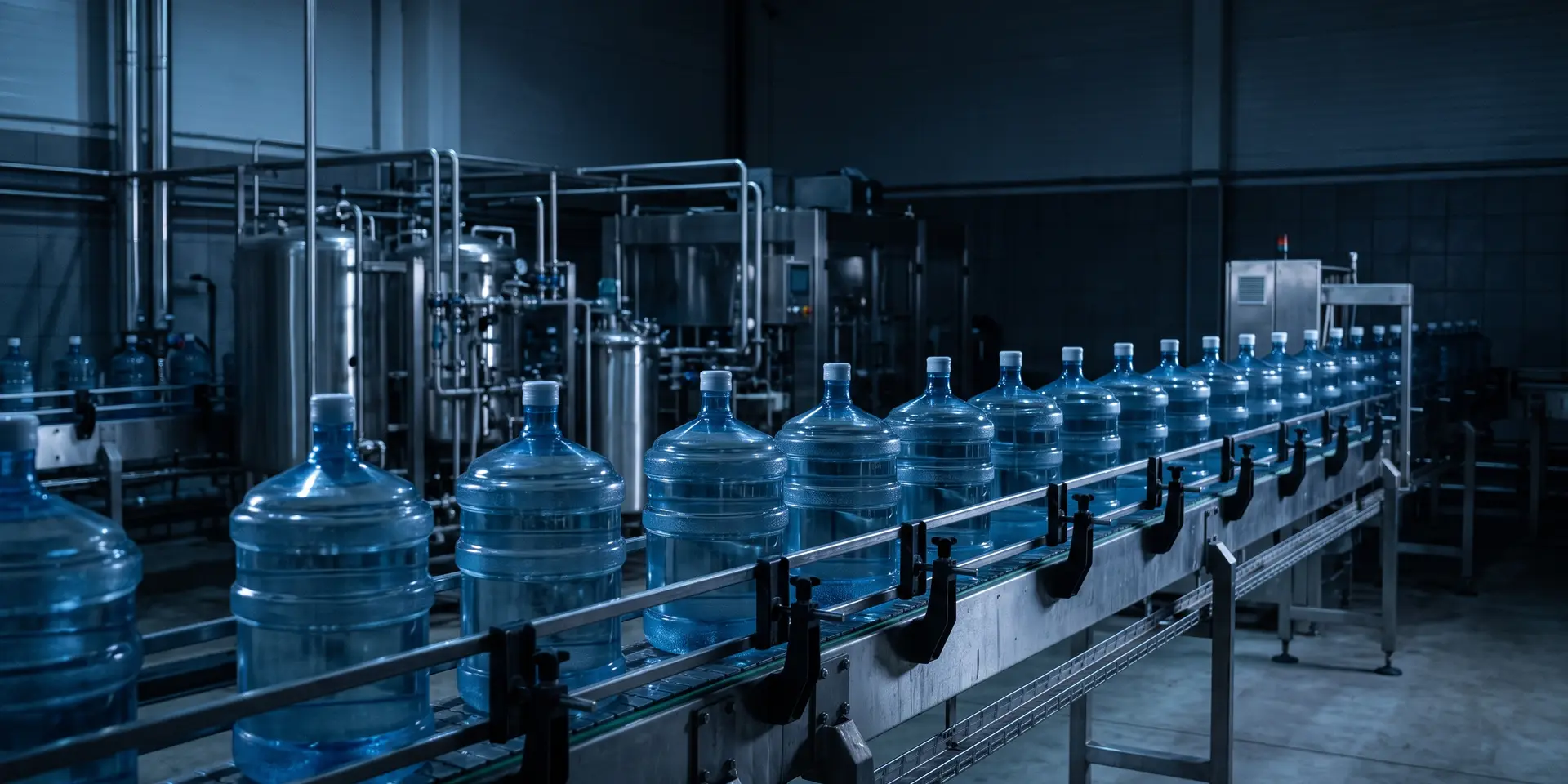
The courier collects the empty bottles on the next visit; there is no need to call anyone separately. We take no deposit for small glass bottles: a refundable deposit exists here only for 19-litre large bottles — 45 000 UZS for polycarbonate and 30 000 UZS for PET. The crate comes back to us, the bottles go to be washed, and that is all.
What happens to the empty bottles after return
The empty crates leave on the same run that brought the full ones. Then the bottles are sorted: intact ones go to the washer and back to the bottling line, chipped and cracked ones go to cullet. We sort them not out of curiosity: how many more cycles a bottle will survive depends on the condition it comes back in.
Washing is not a rinse under the tap. The bottle is soaked in an alkaline solution, the label is removed, it is washed inside with rotating nozzles and rinsed, after which each one is checked against the light. The cycle survives several dozen trips, and what limits it is not dirt but wear: scuffs appear on the neck and base, and bottles are rejected by them.
Rejected glass is remelted, and this is the simplest part of the cycle: glass becomes glass again, any number of times and without losing its properties. Plastic cannot do that — every cycle degrades the material, and the bottle comes back not as a bottle but as fibre or packing strap. This, and not the conversation about taste, is where the material has its most solid advantage.
In practice this means that returnable bottles are counted not by the bottle but by the crate, and losing a crate is more noticeable than losing a bottle. An empty crate left in your kitchen until next month is neither our loss nor your debt, just a slot dropped out of circulation that someone will be short of that same evening. That is why we collect the empties on every run, not once a quarter on a separate order.
- Put the empty bottles back into their own crate — loose, they break in the van
- Do not throw the crates away: the bottles are returnable, and they are counted by crate
- Let us know in the chat if more empties than usual have piled up — the courier will leave room in the van
- Do not pick up broken glass with your hands, just tell us: the replacement comes on the next run
There is no deposit for small bottles, as we said, so there is nothing to check or sign on return. An empty crate is not an amount on your balance but part of the route: it leaves exactly when the next delivery arrives and needs no separate action from you.